The inhabitants of Vineta had ignored all warnings and continued to live it up. Eventually, a terrible storm surge swept the city into the depths. Since then, with a little luck, one can hear the bells of Vineta on Easter morning. Once every hundred years, “Sunday children” can see them rising from the floodwaters. Only a “Sunday child” who can buy something from the residents of Vineta can redeem the city.
Omnipresent on Usedom: The Myth of Vineta
Magazine
07.08.2024, Usedom Tourismus GmbH
The name "Vineta"...
...can be found in many places on Usedom. Streets, piers, hotels, and pharmacies bear the name of the proud trading town that is said to have been swept away by a storm surge off the coast of Usedom. Whether it actually existed and whether it was truly located off the coast of Koserow—no one knows for sure.
The Legend of Vineta
According to legend, one Easter morning in Koserow, a shepherd boy saw a city rise out of the sea while tending his sheep. When Vineta’s merchants offered him their precious goods, he was overwhelmed by the wealth of the city and its inhabitants. Strangely enough, despite all the hustle and bustle, he couldn’t hear a single sound. Since the shepherd boy didn’t have a penny to his name anyway, he eventually returned to his sheep. When he looked around, the magnificent city had vanished once again.
Once the largest and wealthiest city
On the beach, an old fisherman told him that Vineta had been the largest and richest city in Europe, whose inhabitants had traded with every country. Their wealth had gone to their heads so much that they had become wasteful and arrogant. Three months, three weeks, and three days before Vineta’s downfall, the inhabitants had been warned by mirages in the sky. A water nymph had also issued an urgent warning: “Vineta, Vineta, you rich city, Vineta shall perish, for you have done much evil!”

According to legend, a fisherman said that Vineta had been the largest and richest city in Europe.

The bell tower on the Koserow pier is intended to commemorate the legend through the ringing of the “Vineta” bells.
Historical Sources – Did Vineta Really Exist?
In fact, the wealthy city of Vineta is mentioned repeatedly in historical sources dating back to the turn of the millennium. One of the first to describe it was the canon and priest Adam of Bremen around 1075 in his "Hamburg Church Chronicle". The magnificent trading city of Jumne is said to have been the largest city in Europe, where Slavs and other peoples lived together and traded in goods from all the Nordic countries. The city is said to have been located east of Hamburg at the mouth of the Oder River and to have been surrounded on three sides by various bodies of water. Later chroniclers, all of whom cited Adam of Bremen, copied the manuscripts inaccurately. Thus, over the centuries, Jumne became Julin, Jumneta, Vimneta, and finally Vineta.
Searching for Clues – Where Did Vineta Sink?
If the wealthy trading city of Vineta on the Baltic Sea ever existed, where exactly was it located? Historians and archaeologists are by no means in agreement on this point. In addition to the island of Usedom, the island of Wollin and the town of Barth, among others, also claim to be its location. As early as the 16th century, contemporaries considered Koserow—with its former outpost, Damerow—a likely candidate. After all, key aspects of Adam of Bremen’s description hold true: Usedom lies off the mouth of the Oder River and is surrounded by three different bodies of water—the Peenestrom, the Achterwasser, and the Baltic Sea.

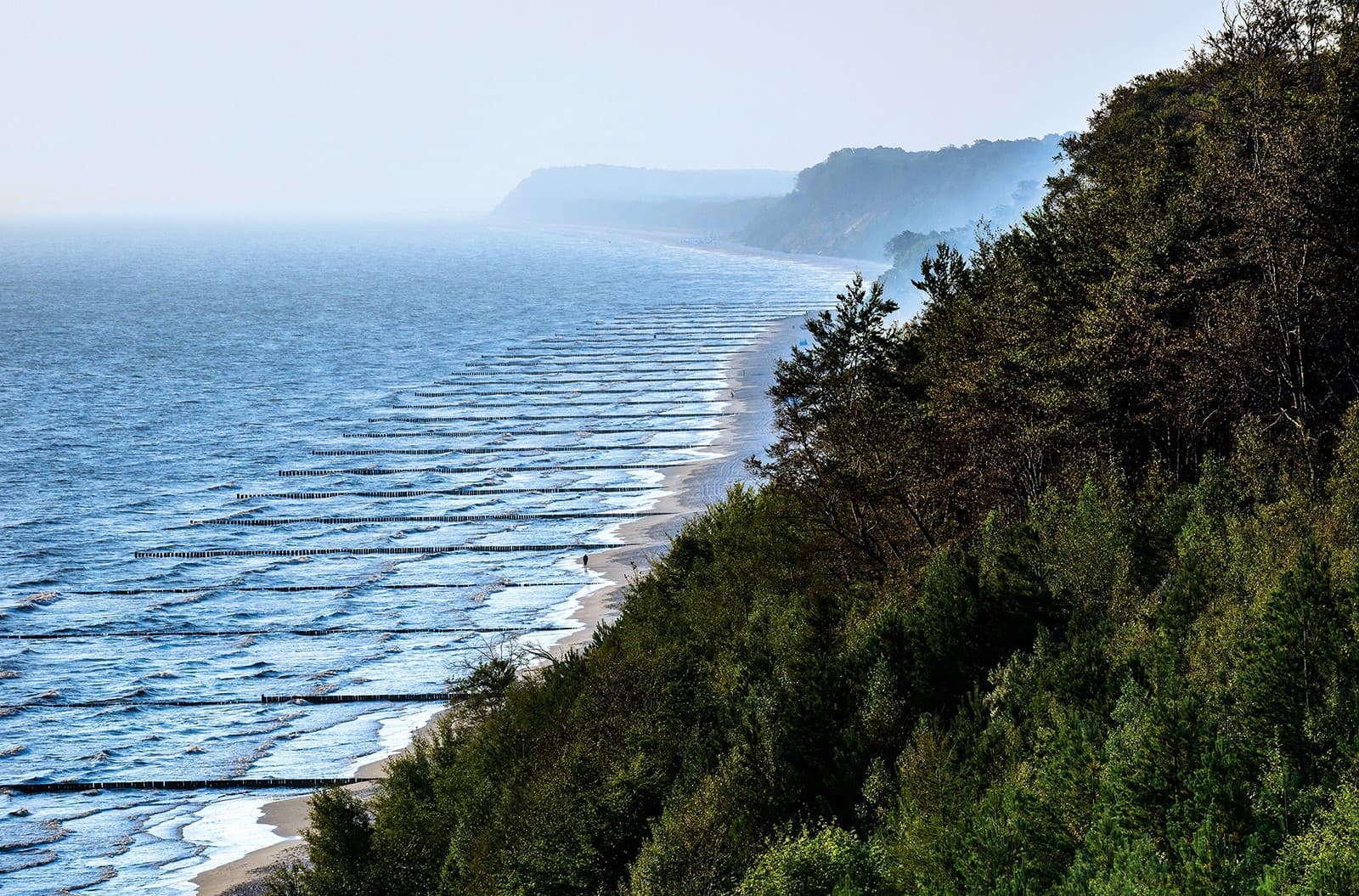
A Fairytale Forest Surrounding the Streckelsberg in Koserow
The Fearsome Reef in the Baltic Sea off Koserow
Another compelling piece of evidence seemed to be the reef in the Baltic Sea off Damerow and Koserow, which was feared by fishermen. Historians of the time believed they could recognize it as the remains of the sunken city of Vineta. Another indisputable piece of evidence was a wooden crucifix that fishermen pulled from the sea at the Vineta Reef. Today we know that the Ice Age rock formations are of natural origin. Nor does the cross come from a church in Vineta; rather, it is a Swedish carving.

Contemporaries place Vineta unequivocally off the coast of Damerow and Koserow.
The Lubin Map of 1618 shows that contemporaries unquestionably located Vineta off the coast of Damerow and Koserow. The Rostock cartographer Eilhard Lubin marked the sunken city directly off Damerow on his map. It’s worth taking a closer look at the historic Lubin map. You can view original prints at the Kaffeemühle Museum of Local History in Wolgast and at Stolpe Castle.

Every Wednesday at 4:00 p.m. on the Koserow pier, you can listen to a reading of the Vineta legend. Afterward, the church bells of the sunken city ring out from the bridgehead. You can also admire the original 15th-century Vineta Cross in the Koserow church. For those who want to learn more about this mysterious city, we recommend the book "Vineta-Trugbilder" by Martina Krüger. The former press spokesperson for the Vineta Festival has researched all the historical facts and myths surrounding Vineta and summarized them in this highly entertaining book.
Share this discovery
By clicking the icons, you leave this website.