Face of the Island: Photographer Jacqueline Illemann

Magazine
Photographer Jacqueline Illemann
©
08.07.2020, Usedom Tourismus GmbH

Jacqueline Illemann has been taking photos since she was 13 years old. Right on the Heringsdorf promenade, you can admire her photos in an old laundry room. Her photos are emotional and reflect the story behind each subject. The photographer recharges her energy on the beach, where she drinks her coffee every morning at six o’clock.

Emotional Photography on Usedom

Ms. Illemann, how did your passion for photography begin?

When I was about 13, I got my hands on my aunt’s Polaroid camera and thought it was absolutely amazing. I experimented with it a lot. I still have a Polaroid today and still enjoy taking it to the beach to take pictures.

How did you end up making photography your career?

I’ve always taken photos in my free time. Professionally, I was an administrative manager in Kassel. That’s where I had my first exhibition in 2010, titled “So lebe ich" ("This Is How I Live"). For that, I visited people at home—people we refer to as intellectually disabled—and photographed them. I also wrote texts to accompany the photos. That was basically how I got started. I then worked part-time for a photographer. And when I moved to Usedom, my photography became more established, and I started my own business in 2015.

What do you like to photograph most?

I love photographing emotions most of all. And those can be found in both landscapes and people. I always try to capture what you can’t actually see. I try to capture the essence of those emotions and convey them through my images. Here on Usedom, of course, it’s mainly the landscape. But before that, I also did a lot of black-and-white photography.
Since I’ve been on the island, color has gradually crept back into my work. I always tell my husband that the sea looks different every day. Here on Usedom, the colors are so beautiful—and sometimes just incredible. When that happens, I simply can’t convert the images to black-and-white.

How would you describe your photographic style?

My work is emotional and artistic. And I try to be unconventional. I have lots of props and outfits that I use for photo shoots. I’m lucky enough to live right on the promenade in Heringsdorf, so I take everything I can use and carry to the beach. Ladders, tables, chairs—sometimes I even build a set. Working in a unique way is very important to me. And even though I can use a studio, 90 percent of my photography takes place outdoors, mostly on the beach.

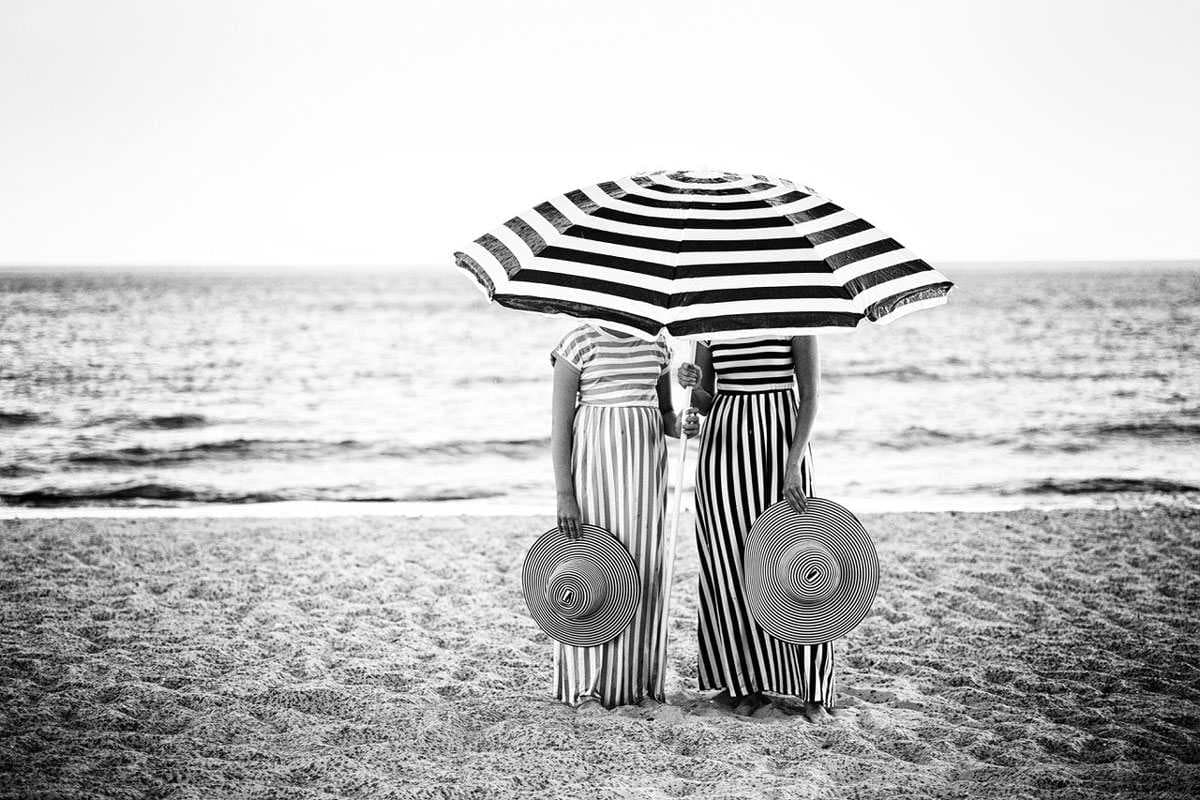
Black-and-white photograph of two people on the beach
©

How did you end up displaying your paintings in an old laundry room?

I moved to the island in 2014 with my husband, who was born in Ahlbeck. We bought the house, which was built in 1904, and this old laundry room was in the garden. As far as I know, laundry was actually washed here in the past, and children were bathed here. When I opened the door for the first time, the laundry room just said to me: “This is where my paintings belong.” It’s very small and simple, but you get the feeling that every stone has its own story. There’s so much to experience in these rooms.

Photos and the Emotions They Convey

Why are you so passionate about photographing people?

For me, the connection with people is unique. You get pretty close to each other when taking photos. And sometimes tears do flow when things get emotionally intense. The people who come to me to have their picture taken usually have a story to tell. And exploring that story is so much fun and a real blessing. Often, both the client and I get goosebumps. It’s a truly amazing experience—and a little bit addictive, too.

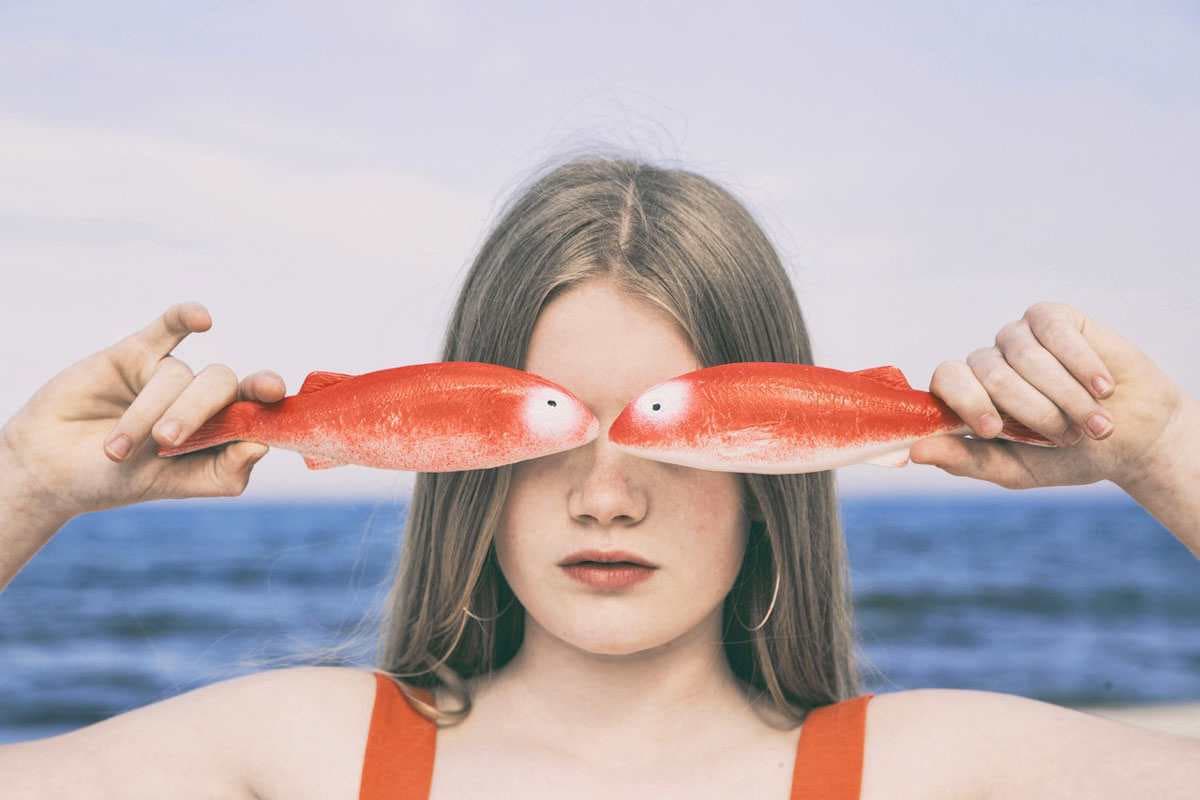
Photograph of a Girl on the Beach
©

You don’t just do photo shoots—you also offer photography workshops. What do participants learn from you?

First and foremost, I instill a sense of enthusiasm. You can’t master photography overnight. A good camera alone doesn’t make a good photo. After all, a chef doesn’t need a good pot to prepare delicious food. It can help, but the food doesn’t depend on it. A good camera is, rather, a means of expressing creativity because it offers much more creative freedom. But I also have participants who take photos with their smartphones. For me, it’s more about mindfulness in photography. With a maximum of six people, we can take enough time for that.

In your opinion, what makes a good photo?

A good photo evokes an emotional response. It makes me look at it longer, and it tells a story. But that also shows that judging a photo is a personal matter. What’s important, though, is that a good photo doesn’t depend solely on technical quality. Technically perfect photos can be completely devoid of emotion.

Is it possible to take emotional photos in all areas of photography? Even if I’m not photographing people, but landscapes or architecture, for example?

Definitely yes, because the mood is always different.

Usedom has a lot to offer photographers

What makes Usedom so appealing to photographers? Why is it worth packing your camera in your vacation luggage?

I think the light and the clouds on Usedom are truly unique. It’s incredible what kinds of patches of light sometimes appear. Plus, there are so many beautiful spots to photograph. Not just along the coast—the inland areas are worth exploring, too. There’s stunning nature and incredible atmospheres here, especially in the early morning hours. Many of these spots are still completely unspoiled, and hopefully they’ll stay that way for a long time to come.

What’s your very own favorite spot for taking photos?

Of course, I love being at the beach, but I also love places like Morgenitz or Mellenthin—where you still get that village feel. But the seaside resort architecture here on Usedom is also fantastic. There are so many great spots that I love.

What do you appreciate most about the island?

The proximity to the sea is, of course, unbeatable. But I also appreciate that we lack for nothing here. I have everything within walking distance and enjoy village life with a pretty good infrastructure. I live right on the promenade and love the peace and quiet here. Our first purchase when we moved here was, of course, a beach chair. And we both promised each other that we’d go to the beach at least once a day.

And do you keep that promise?

Pretty well. Not always, but very often. If we locals can’t manage that—especially since we live right on the beachfront—then who can? In the summer, we always have our first cup of coffee on the beach at six in the morning.

And the tourists who crowd the boardwalk and the beach during peak season—do they bother you at all?

No, not at all. The people are so friendly and pleasant. And of course, we on the island also depend on the tourists for our livelihood. I can’t share the frustration of some of the perpetual complainers here on the island. For me, the visitors are an asset, and I’m very happy to have them here. My partner and I find it so beautiful here and are so happy here that we’re delighted to be able to share this happiness with others. It’s just great to meet people who are as enthusiastic about Usedom as we are.

What’s your personal favorite spot on Usedom when you want to take a break from photography?

I never go anywhere without my camera. (laughs) My favorite spot is our boat on the Achterwasser. It’s a very small motorboat that holds a maximum of six people. And when we want to get out, we take it for a leisurely cruise. We pick up some cake, head out to the Achterwasser, drop anchor, and do absolutely nothing for an hour and a half. We enjoy life and take in the beautiful nature from the water.
And another one of my favorite spots, by the way, is the Niemeyer-Holstein Studio. Not just the studio—the garden is beautiful, too. And when I think about it, Neppermin comes to mind right away. As you can see, there are many lovely spots on Usedom.

Thank you very much for the interview!

Mr. Koprek conducted the interview on behalf of SEM SEO GmbH for usedom.de.

Share this discovery

By clicking the icons, you leave this website.

Book Your Vacation Now